
Some time ago I posted an essay about John Baynum (“J. B.”) Welch. Born in the now-vanished town of New Market, he made his home for most of his life in Milton, raising nine children while operating a drug store and watch repair business at 205 Union Street. He also left a legacy of dozens of poems and songs, many of them religious in nature. Recently, I was surprised to learn that two of J. B.’s compositions – one a song, the other a poem – had a direct relationship with visual works of art that were brought to my attention by David Partridge, a Welch descendant.
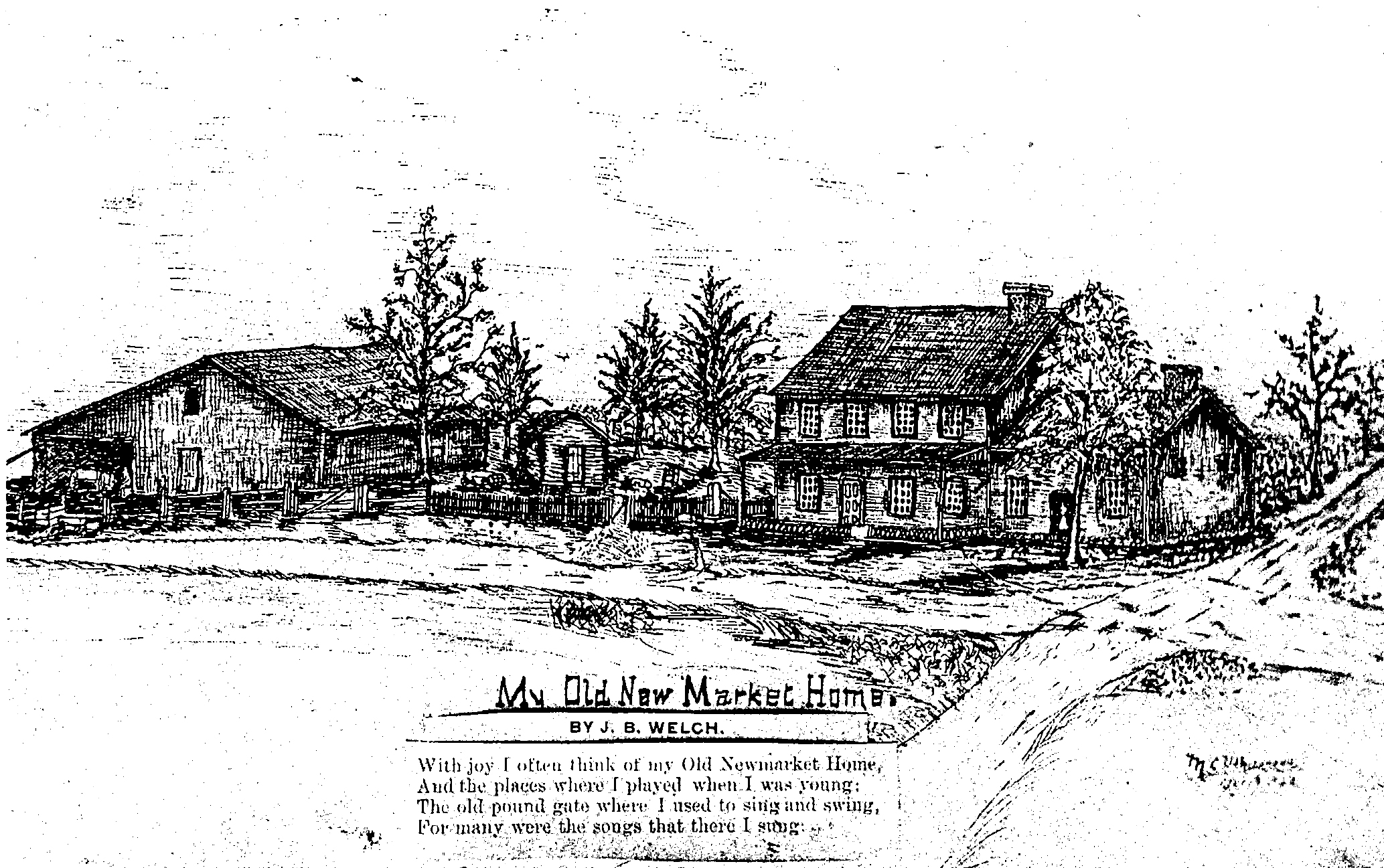
The first of these is an engraving of the old Welch homestead in New Market, executed in 1902 by Mortimer Clifton (“M. C.”) Whitehead, who was about 18 years old at that time. What we know of the engraving is that it was produced from the young Whitehead’s sketch of 1902 and included a stanza from J. B. Welch’s song “My Old New Market Home.” It is not likely that Whitehead executed the engraving, as that required special skills and tools such as might be found at a newspaper. The song lyrics that accompany the engraving were likely to have been composed at a different time and introduced to the public on the occasion of the reopening of the New Market Church in July of 1904. There are no family ties between the Whitehead and Welch families, although they lived within a few miles of each other. In fact, Welch had been gone from New Market for decades when he composed the nostalgic “My Old New Market Home.”
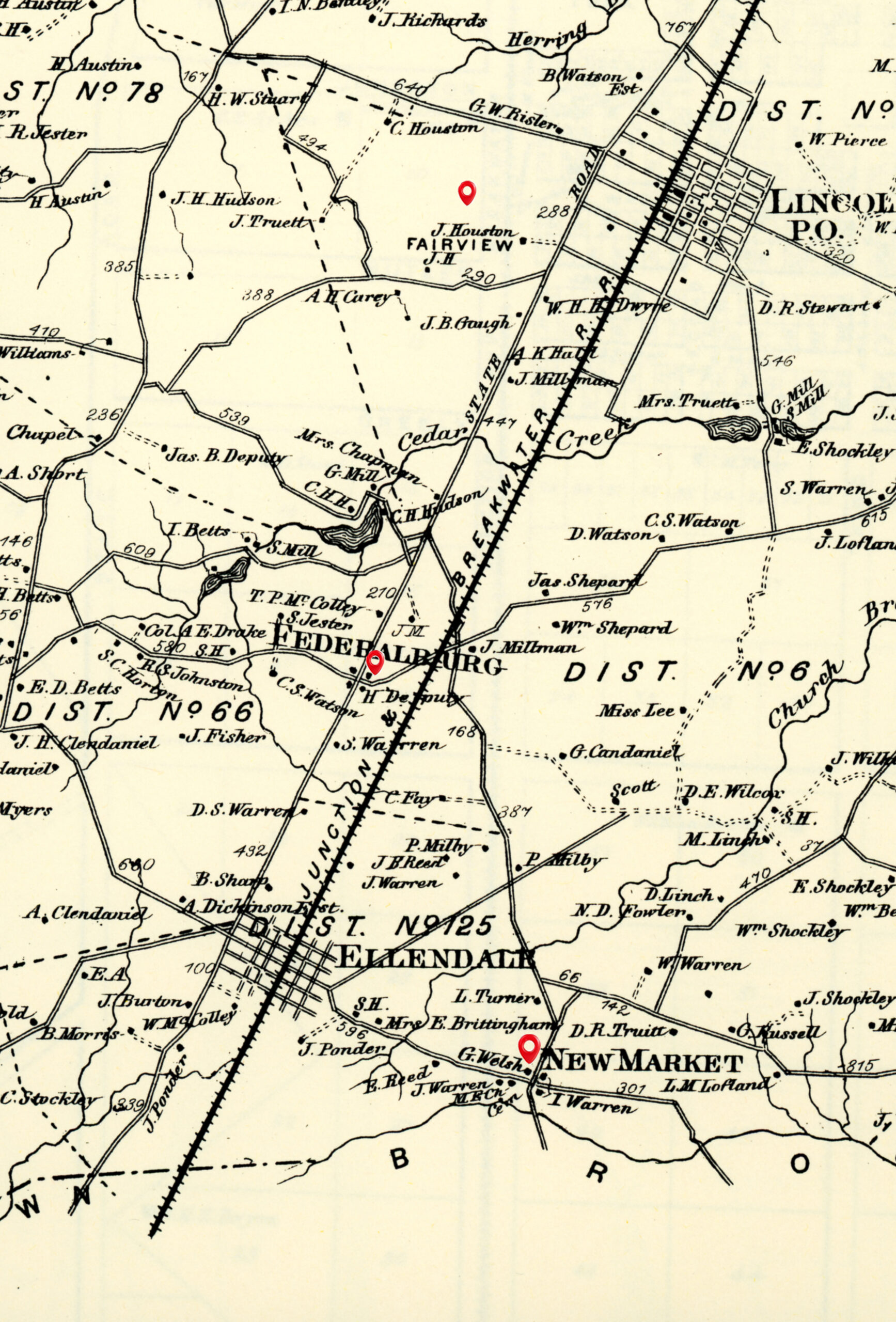
The Welch farmhouse pictured in the engraving was located approximately where Route 240 meets the Ellendale Highway, just east of Ellendale. The location is based on the Cedar Creek Hundred page of the 1868 Beers Atlas which shows a “G. Welch” property there. G. Welch was George Welch, eldest of seven children. George inherited the property from his father Luther Martin Welch, who died in 1855. J. B. was the youngest of the seven siblings, and must have realized early on that he would not inherit anything significant. His fortunes lay seven miles to the east in Milton.
Land records show that Luther Welch came into possession of the farm through his wife Mary Baker, who inherited the land from her father William. Since William died in 1850, the farm came to Luther when he was in his 50s, although the Welches may have lived there as tenants beforehand. George Welch probably inherited the farm after his mother died, in 1859. There is nothing in the records that I could find that would indicate who built the homestead and when.
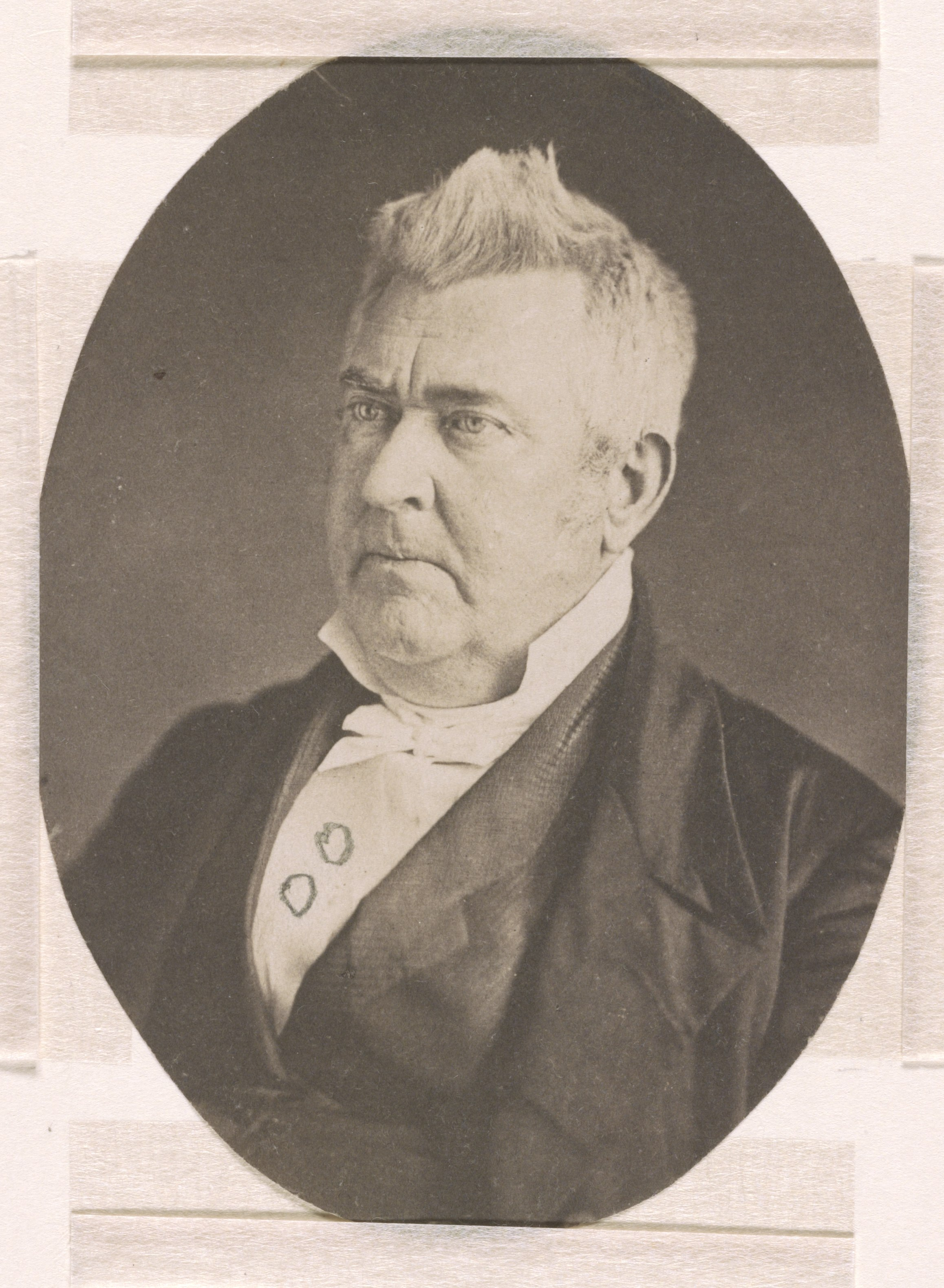
M. C. Whitehead (1884 – 1958) was the middle child of three siblings, born in 1884 to Frederic Augustus Whitehead and Elizabeth Houston Whitehead. M. C. and his sister Laureta were educated at the West Chester (PA) Normal School and became teachers for life, while M. C. moved up the administrative track and as well. For at least two years (1906 – 1908) he was the principal of the Milton Public Schools. The family lived in Lincoln (or Lincoln City as it was then called), just a few miles north of Ellendale. The only publicly known works of art credited to M. C. are the engravings of the Welch homestead and a later engraving of the Fleatown Inn. The latter is also the subject of a J. B. Welch poem.
Fleatown itself was located at the intersection of Old State Road and Fleatown Road, on the stagecoach route; legend says it was named for the fleas travelers encountered there. It was known for its two competing inns, one of them being the Fleatown Tavern (est. 1740) owned by Samuel Warren, the other owned by Milloway Wright. Upon the latter’s death, Warren purchased his tavern and closed it, eliminating the competition and continuing the late-night revelry for which the Inn was well known. One of the more famous patrons of the Fleatown Inn was John M. Clayton, a young lawyer in the 1820s who stopped at the inn on his way home from Dover; he would be elected to two U. S. Senate terms from Delaware and would serve as Secretary of State under Zachary Taylor from 1849 – 1850). The revelry ended and famous patrons ceased coming when Samuel Warren died in 1843, although legends about the Inn took on a life of their own. The Inn remained in place as a residence until 1895, when it was torn down.
(Wikipedia Commons)
The advent of the railroad in the mid-19th century eliminated the stagecoach route and ended Fleatown’s business permanently. The hamlet was renamed Federalsburg (it appears that way on the Beers map of 1868), but today it is an unincorporated area that uses an Ellendale zip code. On the other side of the state line is an actual incorporated village named Federalsburg.

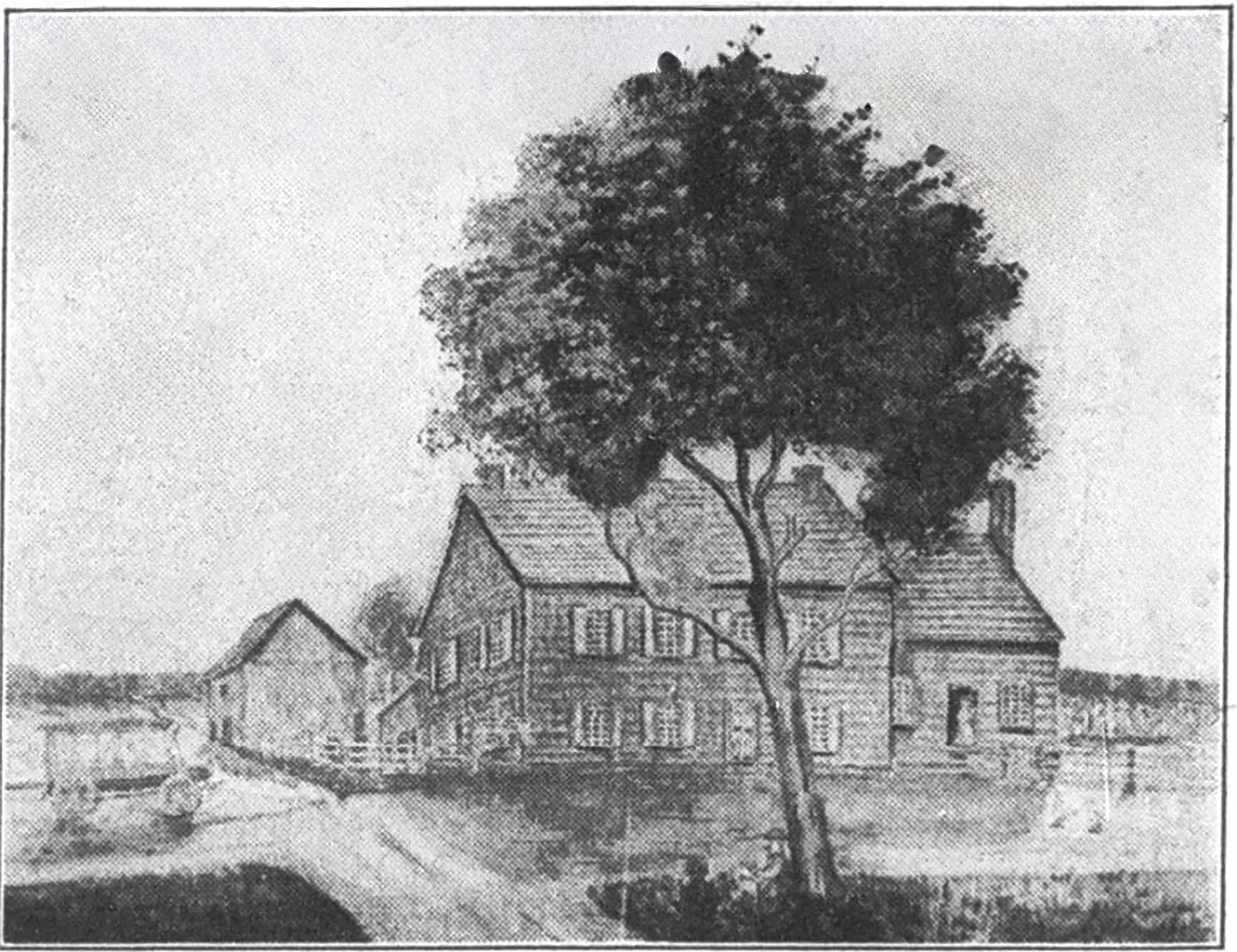
J. B. Welch was old enough to have seen the Fleatown Tavern, even if, in his youth, it no longer operated as an inn but as a private residence. The Milford Chronicle states that Welch “drew a sketch of the inn from memory,” handed it off to M. C. Whitehead who made a painting from it, and was engraved for publication in the Chronicle along with some of the verses of “The Old Fleatown Inn.” The poem makes reference to another famous Delawarean besides John M. Clayton, Cesar Rodney, who stopped off at the Inn in the 18th century, but of greater interest (at least to me) is the verse that refers to a gander “tending bar.” This was a story told by John M. Clayton of the goose that stood guard at Inn’s bar and honked when Clayton appeared seeking refreshment. The story appeared several days running in the Wilmington newspapers during the week of December 17, 1895. Another tale concerns a comment made by Charles Cullen, a retired judge and former Inn customer, in 1895: the Fleatown Inn was a good place for “peach and honey.” Given the Inn’s reputation for “late night revelry,” one can imagine what the Hon. Charles Cullen may have meant by that comment. The modern day usage of the peach and honey emojis may offer a clue.
As for the Whitehead family, the members’ names appeared in the local press with some regularity. In 1903 the eldest son Frederic was nearly brought up on charges for shooting at a fox-hunting party that had trespassed on his orchard. When the DuPont Highway (Route 113) right-of-way was being assembled in 1916, the Whiteheads were the last holdouts before the State condemned thirteen acres of their property for the road construction (in the end, they did receive a fair price for their land). In 1904, M. C. Whitehead’s mother and father sued each other over alleged fraud by Mr. Whitehead in acquiring a controlling share of and selling the farm she had inherited from her father (the Houston Farm in Lincoln). Lastly, a dispute over harvested timber pitted Mortimer against brother Frederic in 1935, a matter that was settled in favor of Mortimer.
M. C. Whitehead served as teacher and principal in Delaware schools (including Milton), and then spent the remaining 23 years of his career in the Philadelphia school system. He attained a graduate degree in education, but none of his artwork besides the two engravings is known to have been published or exhibited.
Sources
Milford Chronicle 2/13/1903, 12/9/1904, 7/12/1907, 6/12/1908, 3/19/1909, 7/30/1915, 10/1/1915, 8/2/1918, 10/1/1935
Wilington Evening Journal 12/17/1895, 5/3/1905
Smyrna Times 5/31/1916
Wikipedia
Phil,
A very interesting and fantastic dig into the early history of our area. Great job!!!
Glad you liked the story Fred. It was fun putting it together.
Wow! So interesting. John Bayne Welch was my great grandfather. His son, John Bayne Welch Jr, was my grandfather. Love reading about my family ties to Milton.
Thank you for your interest!
Hi, I enjoy your blogs and look forward to them. The amount of research and visuals you include is fantastic. I was hoping to reach out to you directly regarding information I am seeking about a specific historical family/place in Milton, but your contact link is not working. Is there a way I can contact you?
Thanks,
Rachel