
Some artifacts, nodescript as they appear on the surface, require examination of their cultural and social context before their value can be appreciated. Such is the case with a recent book that has come to my attention.
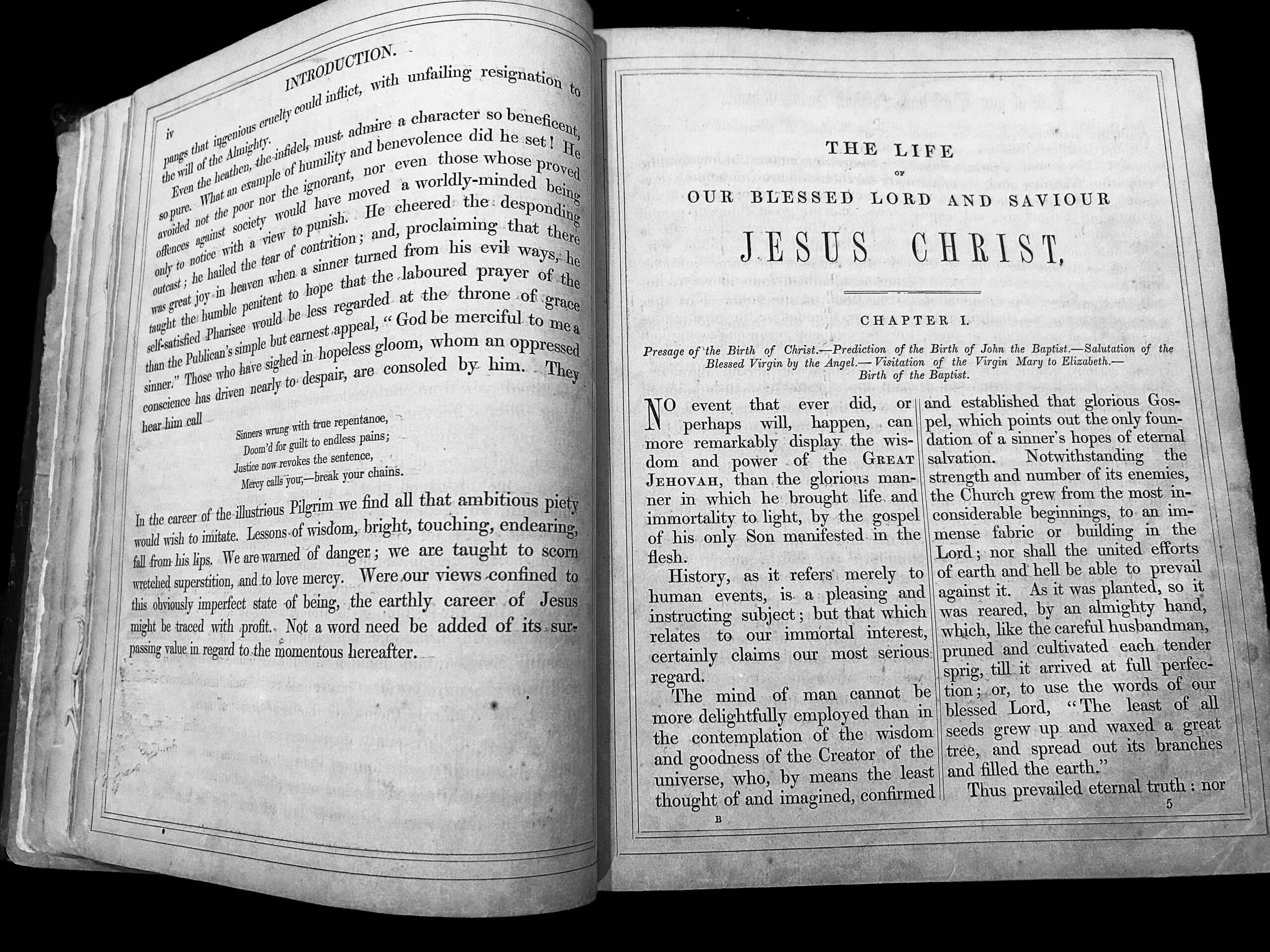
Quarto-size pages of The Life of Our Lord and Saviour Jesus Christ; note the difference in the title here, where the word “Blessed” has been added, and which does not appear in the main title page.
Defending the Faith
From about 1760 to 1890, a publishing phenomenon appeared in the United Kingdom and America: The Life of Our Lord and Saviour Jesus Christ, by the Rev. John Fleetwood, D.D. Its main content was a “harmonization” of the Gospels of Luke, Mark, Matthew, and John – the life of Jesus Christ – into a single chronological narrative. The author added a section as well on the lives of the Apostles. The tone of the prose was pious but not as formal as the King James Version of the Bible, easier to read and to use as an instructional tool by families.
Over the span of time it remained in print, sales of the book were comparable to that of a modern best-seller. It is estimated that 150 million copies were printed during the 18th and 19th centuries. Though not a Bible, it was a companion work to the New Testament.
Its appearance at the height of the Enlightenment was not a coincidence.
The various philosophical currents we now call the Enlightenment were characterized by an emphasis on reason, empirical evidence, and the scientific method. The Enlightenment promoted ideals of individual liberty, religious tolerance, progress, and natural rights. Its thinkers advocated for constitutional government, the separation of church and state, and the application of rational principles to social and political reform. Thomas Jefferson, heavily influenced by the Enlightenment’s ideas, incorporated them into the Declaration of Independence in 1776. In 1789, Jefferson and the Marquis de Lafayette contributed to the writing of the Declaration of the Rights of Man, ultimately credited to the Abbé Sieyès.
While the U. S. Constitution in 1789 mandated separation of church and state as a natural progression of Enlightenment ideas, the French National Assembly took a different approach. Dominated by radical elements, the Assembly initiated a very aggressive program of anticlericalism during the ten peak years or the French Revolution, leading to violence against the Catholic Church, its hierarchy and adherents, and in the end, all Christians. It was an overt attempt to “de-Christianize” France and eliminate the First and Second Estates (clergy and nobility). Both of these social classes were blamed for the oppression of the country’s ordinary people. One could look at “de-Christianization” (or secularization) as the triumph of rationalism over superstition. For the victims of the purge, which included clergy, aristocrats, and the faithful, this was the Enlightenment’s nightmare scenario – the Reign of Terror.
The author of The Life of Our Lord and Saviour Jesus Christ wrote it thirty years before the French Revolution, and could not have envisioned the horrors of rationalism run amok. He did, however, fear the non-violent erosion of religious faith in the English-speaking world through the rationalism of the Enlightenment. The book was written as an orthodox, conservative, pious and accessible countermeasure to the tracts published by supporters of the Enlightenment, in particular the Deists who considered God the “Great Architect” or “Clockmaker” who set Creation in motion but did not intervene through miracles or supernatural events.
The way the book came to be published and distributed was very savvy for its time, and it begins with an enigma: there is no record of a Rev. John Fleetwood ever having existed. Whoever actually wrote the book remains unknown; the text may even have been drafted by committee. Decades of research has failed to identify the author.
The public did not know that John Fleetwood was a pseudonym; affordability was a much greater concern. Leather-bound books in the 18th and 19th century were expensive, and the cost of binding hundreds of pages would put the book out of reach of most of the very audience it was intended for. For that reason, the publisher serialized the release in 25 or more sections that could be bought individually at low cost, and eventually bound together, thus spreading the cost out over time.
The Life of Our Blessed Lord and Saviour Jesus Christ had no actual author and thus no copyright protection. It had many publishers in the 18th and 19th century throughout the English-speaking world who freely copied and distributed the book. Each publisher added their own supplements to the volume to fortify readers’ defense of their faith against the forces of erosion. In the United States, experiencing the Second Great Awakening (religious revival) in the first half of the 19th century, fears of erosion of faith were misplaced; evangelical fervor was strong, and the association of the Second Great Awakening with social causes such as abolitionism, woman suffrage, and the temperance movement gave religious expression great vigor. By the time the book reached American publishers in Boston and New York, the public wanted a large bound book suitable as a family heirloom.
The Family Heirloom
I have recently come across a copy of The Life of Our Lord and Saviour Jesus Christ in one of its American versions. There is no publication date on the title page, but the date of publication can be narrowed down to the four year window during which its New York City publisher, R. Martin, was active: 1850 – 1854. It contained more than 700 pages including supplemental essays and many steel-plate engravings set apart from the preceding pages with tissue paper. It was bound in brown leather and had gilt trim on the cover and the page edges. This was a massive, coffee-table book for affluent families. It was also one that was used to record family history, much as Bibles were.
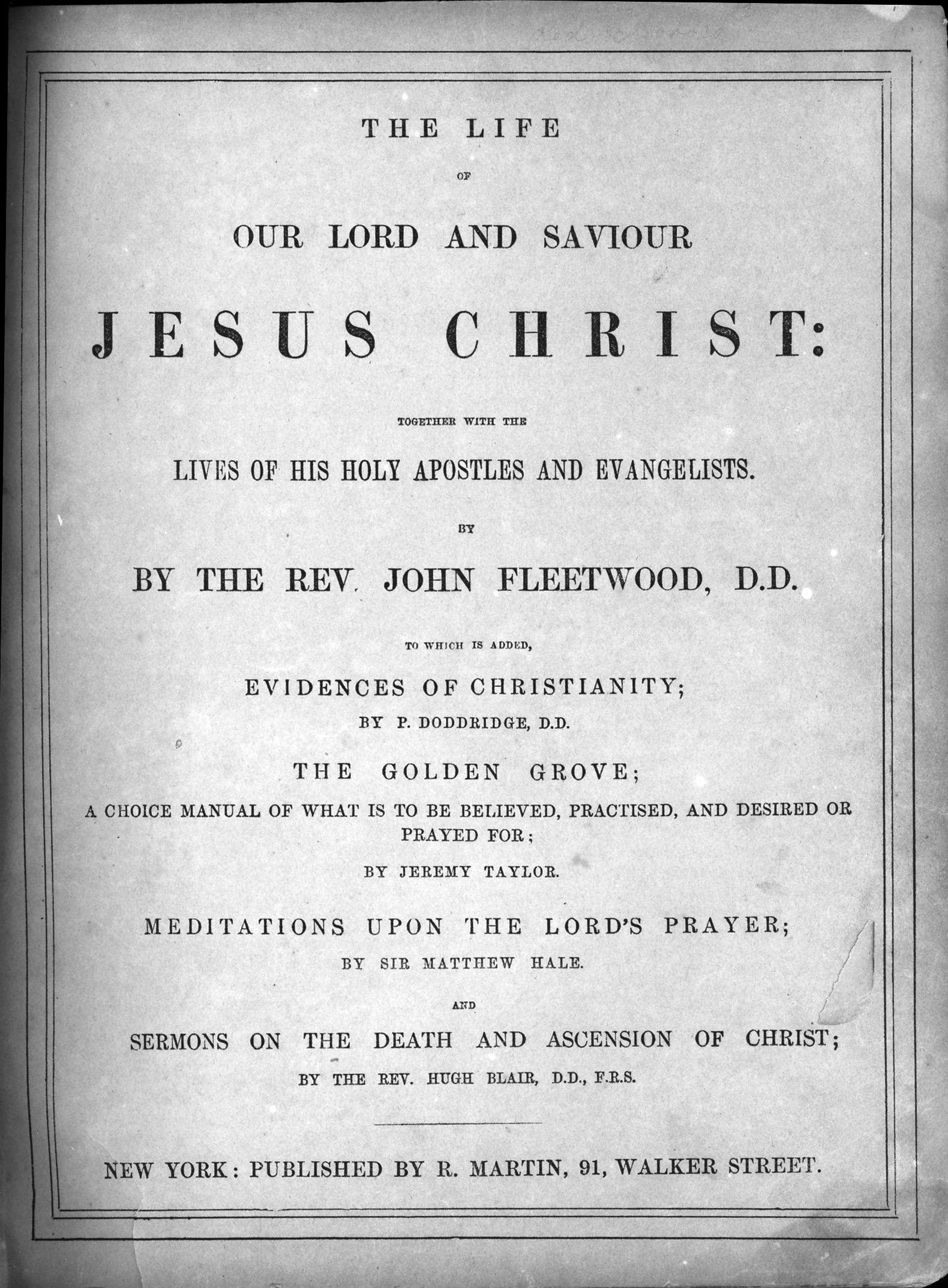
Title Page (note the absence of publication year)
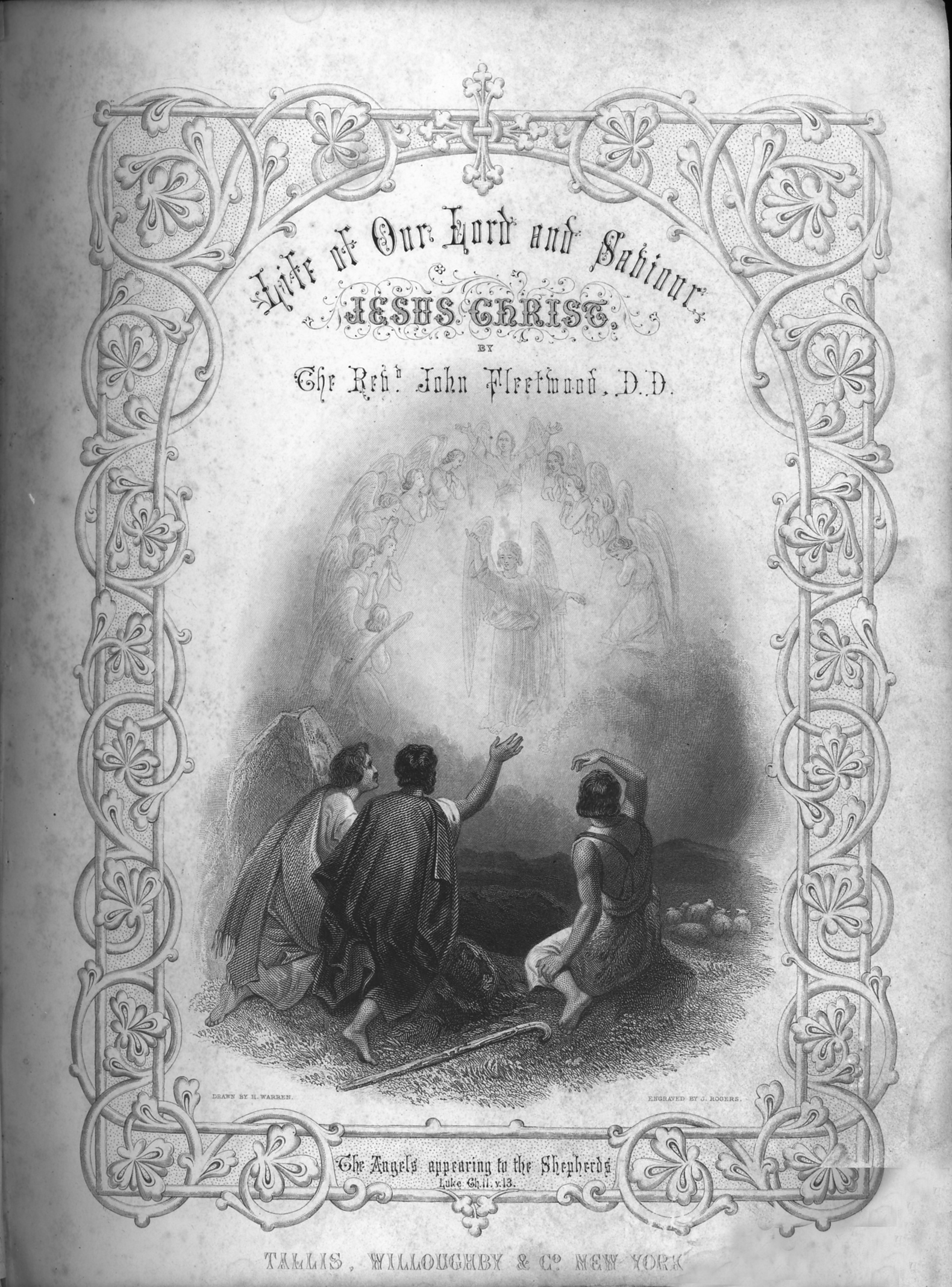
One of the dozens of steel-plate engravings included in the book. The technology to produce these engravings was not available in the U. S. in the pre-Civil War era, so the engravings were typically ordered from engravers in the United Kingdom (in this case Tallis, Willoughby and Company, which had a New York sales office). J. Tallis made his mark as a cartographic publisher employing a network of engravers and artists. The engraver (J. Rogers in this instance) worked from a drawing or painting by an artist (H. Warren, in this instance), and both were credited although their names were difficult to make out. Engraving was supplanted by lithography in later decades of the 19th century.
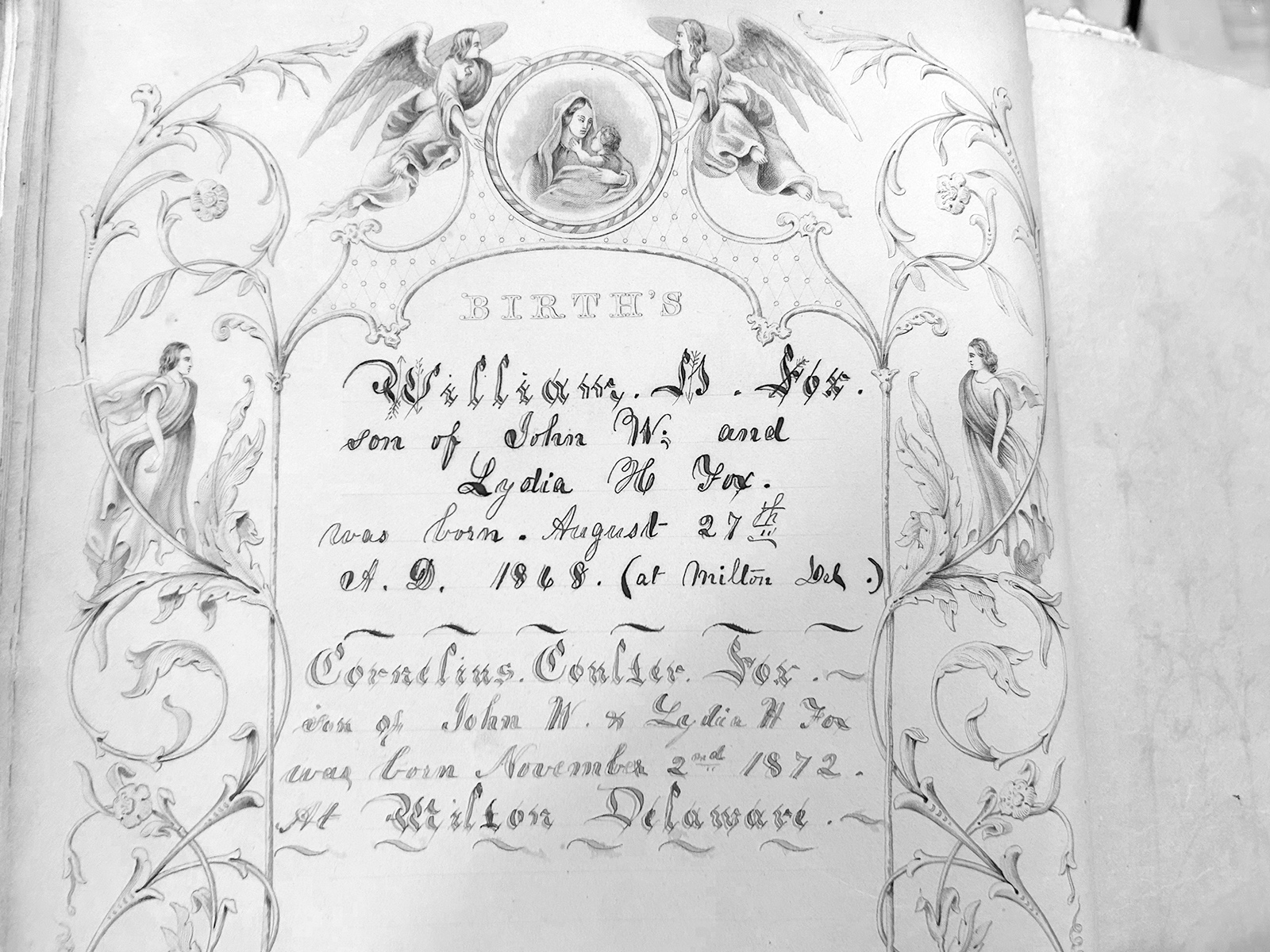
Births Page
The Births register page records the birthdays of William Husbands Fox and Cornelius Coulter Fox in 1868 and 1871, respectively. The entries are written in a highly ornamental, Gothic-like hand, probably by one of the parents, but at different times judging by the differences in the weight of the script. This, plus the absence of other entries made by them, suggests to me that Lydia and John W. Fox acquired this book after they were married (ca. 1865) but did not make entries in it until the children were born.
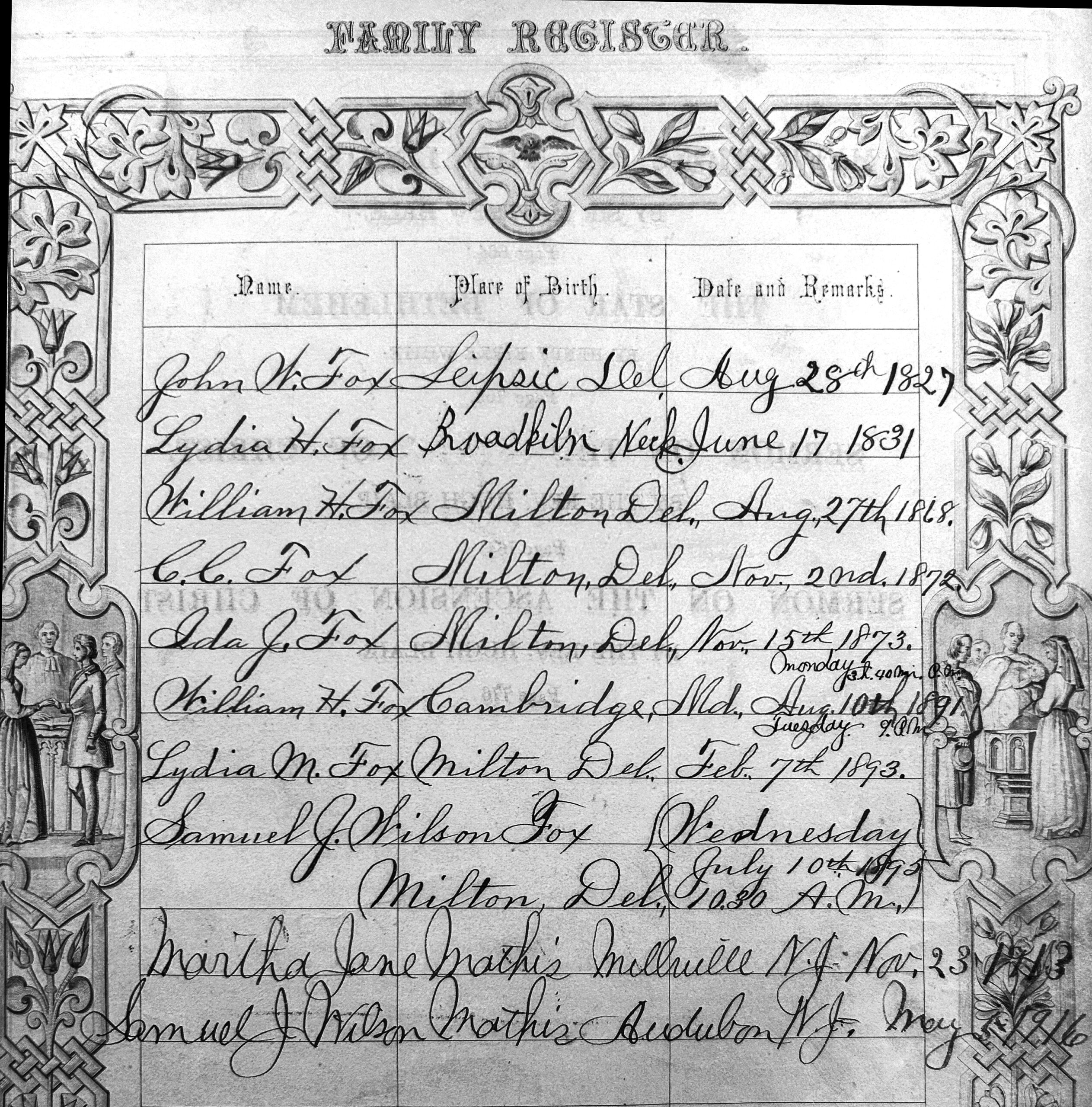
Family Register Page
It is the family register page however, that provides the strongest clues as to who owned the book: Ida Wilson Fox, one of Milton’s more unique personalities and the daughter of Samuel J. Wilson, the undertaker and merchant. The first two entries, Lydia H. and John W. Fox, were Ida’s mother-in-law and father-in law; William H. Fox, the third entry, was Ida’s husband, whom she married in January of 1890. C. C. Fox (Cornelius Coulter Fox) was her brother-in law. Entries six through eight are Ida and William Fox’s three children, William Jr., Lydia, and Samuel J, Wilson Fox. Curiously, the entries for Ida’s first two children record a duration, presumably that of labor, and the time of birth for the third child, Samuel. I don’t know how common a practice this was among families in the 19th century.
It should be noted that all of the first eight entries were written in the same hand, most likely Ida’s. She married into the Fox family in 1890, so a fair assumption would be that the Fox family gifted the heirloom book to the newlyweds. Already close to 40 years old, the book had not had any new family entries until Ida acquired it.
The last two entries on the page are Martha Jane Mathis and Samuel J. Wilson Mathis. These were Ida’s only two grandchildren, born in 1913 and 1916, respectively. The names are written in a different hand, possibly by their mother Lydia Fox Mathis.
The deaths register is striking for the number of family members passing away in a twenty-year period. The first entry is Ida’s two-year old son, Samuel J. Wilson Fox; her father-in-law followed in 1901, then her ex-husband William in 1909. Her mother-in-law Lydia passed in 1910, and her first-born, adult son William – founder of the original Milton Theater – in 1919, at the age of 28. Ida’s mother and father died in 1936 and 1937, respectively, but then a curious name appears between those two: Mrs. Miller. This apparently unrelated person was Catherine Miller, widow of Dr. Lemon Beam Miller. The connection to Ida Fox is unknown. All of the first eight entries in the death register were written in the same hand, most likely Ida’s; the final two, of her sister Margaret and brother-in-law Frank B. Carey, were written by someone else.
The Fox family heirloom is important to us for its direct connection to Ida Fox – a significant figure in early 20th century Milton – and as an example of an international cultural phenomenon.
Ida Fox was such an incredibly interesting character. And reading this, I did not fully understand the magnitude and frequency of loss that she had to deal with, makes one extremely sympathetic to her eccentricities.
She commands a lot of respect in my book. People in the early 20th century were more familiar with death and dying than we are, but losing two of your three children, like she did, would still rip your heart out.
Very interesting! Thank you for sharing.
Thanks for your interest, Dawn!