
The Milton Historical Society recently made me aware of a connection between a prominent Milton family and a U. S. Senator. The parties involved are Annie Ponder (1825 – 1912), sister of Governor James Ponder, and her husband Willard Saulsbury Sr. (1820 – 1892). Annie remained in the shadows of her famous family and then of her husband; little is known about her. Willard Saulsbury, on the other hand, attracted considerable attention (mostly negative) during his career as an attorney and politician.
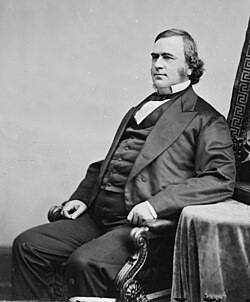
Graduating from what is now known as the University of Delaware, Saulsbury set up a law practice in Georgetown in 1845, and immediately became active in Delaware state politics as a Democrat. He was appointed Attorney General for the state in 1850, and married Annie Ponder that same year.
The political history of the U. S. in the decade preceding the Civil War was fraught. There was the birth and ascendancy of the Republican Party[1], the fracturing of the Democratic Party along sectional lines[2], and several attempts to reach compromises that would balance the power between northern and southern states – compromises that satisfied no one. The rise of Abolitionism in the northern states took on a moral, almost evangelical fervor that southerners, especially the wealthier class of planters, viewed as a threat to their economy as well as their way of life. In the election of 1860, southern Democrats put up their own candidate, John C. Breckinridge, who siphoned votes from the northern Democrats, who ran Stephen Douglas. The result was a victory for the Republican Party that put Abraham Lincoln in the White House. Lincoln never campaigned on an Abolitionist platform, but he and his fellow Republicans opposed the expansion of slavery to the western territories. Republicans in general and Lincoln in particular were thus viewed by southerners as anti-slavery and an existential threat to the South. For some southerners, he was the anti-Christ in a frock coat and top hat.
For the southern states, the election of Lincoln was the last straw. Eleven states seceded from the Union. Their representatives and senators in the U. S. Congress left with the secessionists, leaving a diminished Democratic Party in the District of Columbia. In what remained, there was another split: Peace Democrats vs War Democrats. Though not distinct parties, these factions were in serious conflict with each other. The War Democrats aligned themselves with Republicans and saw military action as the only way to save the Union. The Peace Democrats rejected war altogether, called for a negotiated peace that preserved the Union, and left slavery untouched. They regarded the war as unconstitutional, and too costly in lives and money to pursue. They actively opposed conscription and encouraged desertions. It is not surprising, then, that many in the north regarded Peace Democrats as treacherous and treasonous. It is why their political foes likened them to “Copperheads,” a type of venomous snake common to the eastern U. S.[3]
Willard Saulsbury Sr. was a Copperhead. Delaware was a non-secessionist, agrarian border state with a population largely sympathetic to the Confederacy, so Saulsbury’s stance is not surprising.
Copperheads vigorously promoted three principles:
- “Peace over Union By Force,” essentially an anti-war position that called for an immediate cease-fire, and a negotiated peace with the Confederacy;
- Opposition to ending slavery in general and Abraham Lincoln’s Emancipation Proclamation in particular as an unconstitutional overreach of the Federal government;
- Opposition to conscription in the Union states and to wartime measures.
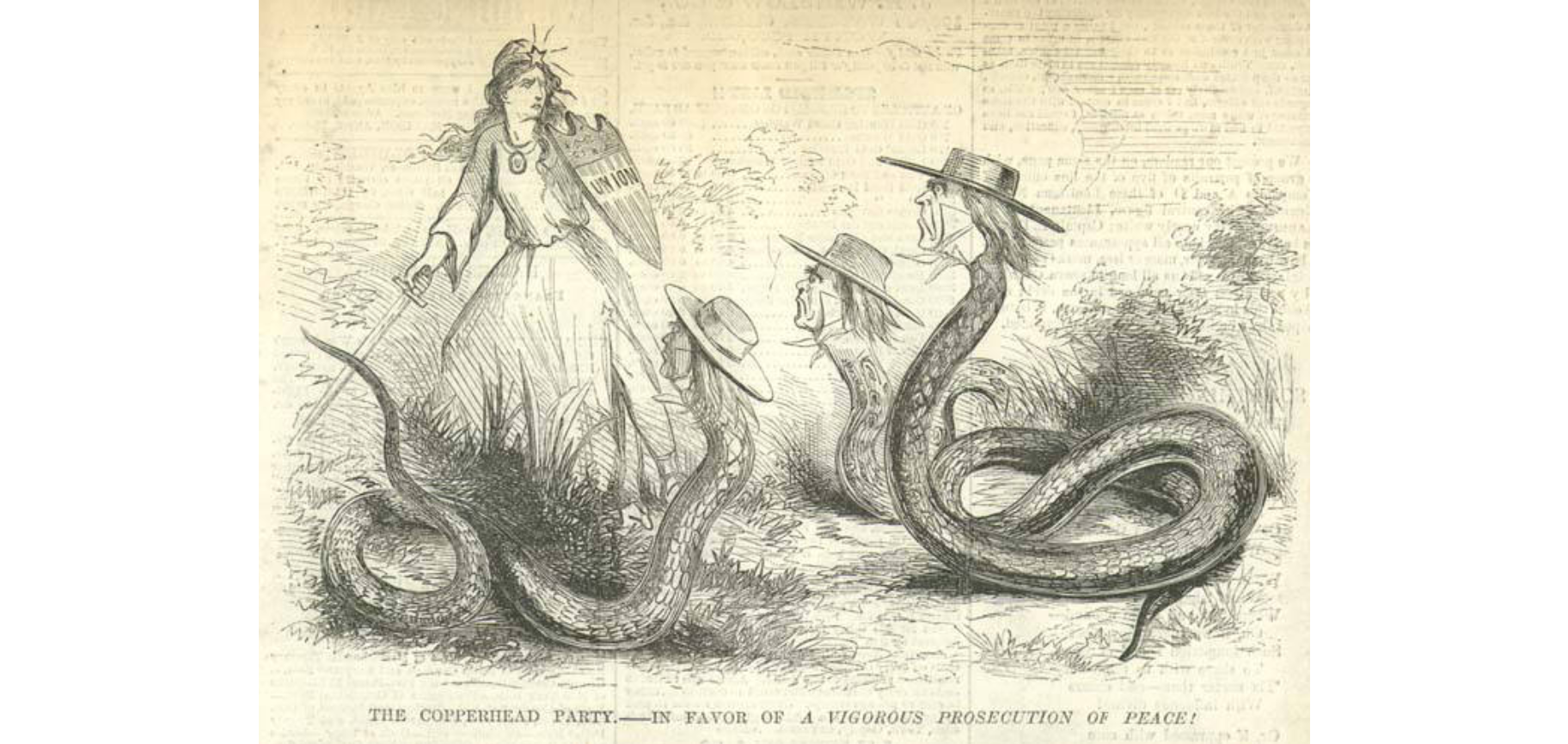
The Copperhead Party – In Favor of a Vigorous Prosecution of Peace
The strongest support for Copperheads came from Midwestern states that had economic ties to the South, and large cities like New York, site of vicious anti-draft riots pitting white immigrants against Blacks. The case with a border state such as Delaware is more complicated. The editors of Wilmington and Georgetown newspapers were vehemently opposed to Copperheads[4][5], yet there was substantial support for the faction among the electorate. In the election of 1864, Kent and Sussex Counties showed a majority voting for Copperhead candidates[6] while that faction polled a substantial minority in the New Castle County hundreds. The Delaware state legislature was Copperhead-controlled.[7] Despite the great number of Copperhead sympathizers, Delaware remained loyal to U. S. Government and the war effort.
This is the context needed to understand, if not excuse, Willard Saulsbury’s behavior in the Senate.
Born in Kent County and a graduate of what is now the University of Delaware, Saulsbury began his career as an attorney. He entered politics in 1850 serving as the Delaware Attorney General, the same year he married Annie Ponder. In 1858, he was elected by the Delaware State Senate to the U. S. Senate (there was no direct election of U. S. senators by voters until 1913). Senator Salisbury. There are conflicting assertions as to whether Saulsbury himself owned slaves, but his family certainly did; as of 1860, he does not appear in the slave census of that year as an owner.[8]
Coming from a Democrat-controlled state with strong Copperhead presence in the legislature, it comes as no surprise that by 1863 Saulsbury was vitriolic in his speeches on the Senate floor criticizing Republican proposals and vilifying Lincoln.
On January 29, 1863, Senator Willard Saulsbury of Delaware rose in the United States Senate and launched a blistering attack on Lincoln and his Emancipation Proclamation. Although the proclamation did not free slaves in Delaware and the other Border States, Saulsbury, as well as his colleague, James A. Bayard, claimed that its effect would be to flood his state with the freed slaves of rebels, creating racial conflict and serious social problems. He defiantly declared that, though opposed to secession, he would keep Delaware “a slaveholding State now and forever.” The senator, who had been drinking heavily, then leveled his rhetorical guns on Lincoln. Saulsbury characterized the president as a tyrant who had acted in perfect disregard of the Constitution and the rights of the people. He proclaimed Lincoln “a weak and imbecile man; the weakest man that I ever knew in a high place; for I have seen him and conversed with him, and I say here, in my place in the Senate of the United States, that I never did see or converse with so weak and imbecile a man as Abraham Lincoln, President of the United States.” Vice President Hannibal Hamlin, who was in the chair, ruled Saulsbury out of order and directed the sergeant-at-arms to escort the belligerent Delaware senator from the chamber.[9]
It is at the point where the sergeant-at-arms approached Saulsbury to escort him out of the Senate chamber that accounts diverge. Saulsbury is said to have waved a pistol in the air, or implied that he had one on his person, or raised it to the head of the sergeant-at-arms. He was unequivocally out of order with or without a pistol.
Decried by every Republican and every War Democrat, Saulsbury’s speech should have resulted in his censure and expulsion from the Senate, neither of which happened. He completed two full terms, leaving the Senate only when two of his brothers ran against him, and one of them, Eli Saulsbury, won. He would finish his career in politics as Chancellor of Delaware from 1873 to 1892, dying suddenly while in office.
The clout wielded by the Copperheads in American politics diminished after the Battle of Gettysburg and through the rest of the war, as the Union started to rack up one important victory after another and the outcome became apparent.
Willard Saulsbury’s attitude toward Black people did not change with the ratification of the 13th and 14th Amendments. He and his brother-in-law Governor James Ponder fought every attempt to implement Reconstruction in Delaware, making it a Jim Crow state for the next 100 years.
[1] https://en.wikipedia.org/wiki/Republican_Party_(United_States)
[2] https://en.wikipedia.org/wiki/History_of_the_Democratic_Party_(United_States)
[3] https://en.wikipedia.org/wiki/Copperhead_(politics)
[4] Delaware State Journal and Statesman (Wilmington), October 20, 1863, page 2
[5] The Union (Georgetown), October 16, 1863, page 2
[6] Delaware State Journal and Statesman (Wilmington), October 7, 1864, page 2
[7] The Union (Georgetown), March 4, 1864
[8] https://en.wikipedia.org/wiki/Willard_Saulsbury_Sr.
[9] His Loyal Opposition: Lincoln’s Border States’ Critics, Journal of the Abraham Lincoln Association, Volume 32, Issue 1, pp 1-17, http://hdl.handle.net/2027/spo.2629860.0032.103